


AJA KONA-4-R0-S05 - KONA 4
1056780

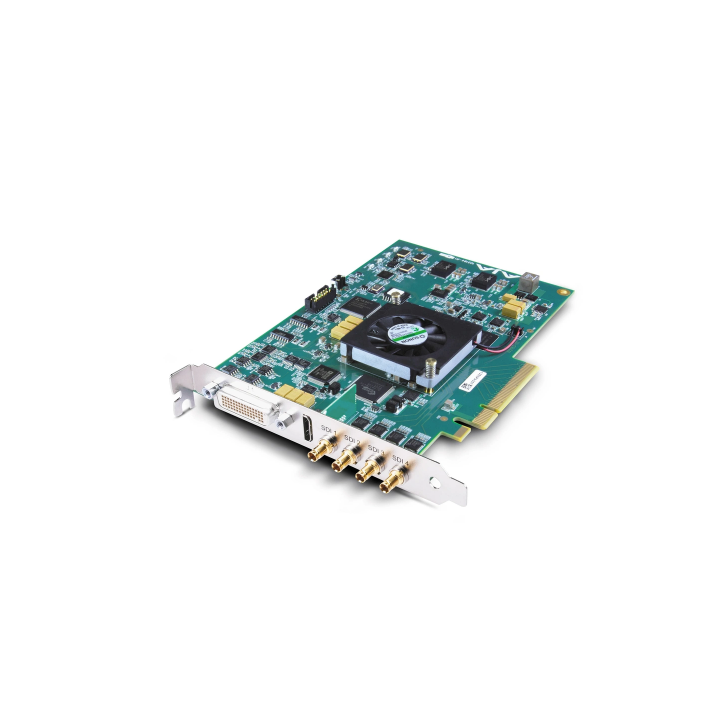

OEM, SD/HD/4K 8-Lane PCIe Card, with Short SDI Cables 101999-02 and Breakout Cables
Visuals Price
2,155.55 CHF
VAT excl.
2,330.15 CHF Inc. VAT
Manufacturer price 2 269,00 CHF VAT excluded
Made to order
-
Delivery
- Shipped in 2 to 3 weeks
-
In-store pickup
- Available in 2 to 3 weeks
AJA KONA 4
Utilising integrated hardware processing, the AJA KONA 4 R0-S05 card can ingest and output video at 4K resolution up to 60 fps. At this resolution, you can view the details of your production natively on a 4K monitor. In addition to 4K resolutions, the KONA 4 supports uncompressed 1080p I/O with 4:4:4 or 4:2:2 colour subsampling. The KONA 4 can simultaneously receive and output uncompressed video via its 3G-SDI ports. Two ports accept video input whilst the other two can feed a professional display or output to a recorder. Hardware processing also enables up-conversion, down-conversion and cross-conversion. Typically, to unify project resolution, footage must be converted or rendered in software to match the project. Thanks to its internal hardware scaler, the KONA 4 can unify the resolutions of your project's video clips without prior rendering. In addition to conversion, the KONA's internal processing can overlay graphics onto a video stream for rapid keying. The KONA 4 includes a 60-pin breakout cable for greater I/O flexibility. Additional inputs and outputs include AES/EBU audio, LTC and Reference BNC connections, component analogue video and RS-422 machine control. Also included are a 4-BNC to mini-BNC breakout cable and an HDMI to mini-HDMI cable. The KONA 4 can also be used in a rack configuration with the optional K3G breakout box. The K3G fits into a standard 19" rack space and features connections to take advantage of all the I/O offered by the KONA 4. High Frame Rate (HFR) 4K Support The KONA 4 supports 50p and 60p up to 4K resolutions. 4K can be input or output using all four BNC connections for broadcast and professional equipment, or the HDMI port to connect to 4K computer monitors or consumer equipment such as televisions. Versatile Integration The KONA 4 supports Windows and Linux, offering 4K and multi-channel power for a wide range of applications. Mac support will be available in the future. Hardware Keying The integrated hardware downstream keyer enables graphics and images to be overlaid onto the card's input video for compositing. Hardware processing provides the computing power needed to quickly create a composite without prior rendering. Hardware Conversion The KONA 4 performs hardware up-conversion, down-conversion and cross-conversion to unify resolutions. Hardware conversion simplifies workflows and eliminates the need to adjust resolution using software. If your project is at 1080p resolution and you have NTSC standard-definition content, the internal scaler will process and convert the NTSC footage to match the project's 1080p resolution. If the NTSC footage has a different aspect ratio (4:3), you can choose how you want the KONA 4 to handle it. It can be processed with letterboxing or anamorphic stretching to fit the 16:9 HD frame. As this conversion is performed using the KONA's hardware, it occurs in real-time, so no prior rendering is required.
Utilising integrated hardware processing, the AJA KONA 4 R0-S05 card can ingest and output video at 4K resolution up to 60 fps. At this resolution, you can view the details of your production natively on a 4K monitor. In addition to 4K resolutions, the KONA 4 supports uncompressed 1080p I/O with 4:4:4 or 4:2:2 colour subsampling. The KONA 4 can simultaneously receive and output uncompressed video via its 3G-SDI ports. Two ports accept video input whilst the other two can feed a professional display or output to a recorder. Hardware processing also enables up-conversion, down-conversion and cross-conversion. Typically, to unify project resolution, footage must be converted or rendered in software to match the project. Thanks to its internal hardware scaler, the KONA 4 can unify the resolutions of your project's video clips without prior rendering. In addition to conversion, the KONA's internal processing can overlay graphics onto a video stream for rapid keying. The KONA 4 includes a 60-pin breakout cable for greater I/O flexibility. Additional inputs and outputs include AES/EBU audio, LTC and Reference BNC connections, component analogue video and RS-422 machine control. Also included are a 4-BNC to mini-BNC breakout cable and an HDMI to mini-HDMI cable. The KONA 4 can also be used in a rack configuration with the optional K3G breakout box. The K3G fits into a standard 19" rack space and features connections to take advantage of all the I/O offered by the KONA 4. High Frame Rate (HFR) 4K Support The KONA 4 supports 50p and 60p up to 4K resolutions. 4K can be input or output using all four BNC connections for broadcast and professional equipment, or the HDMI port to connect to 4K computer monitors or consumer equipment such as televisions. Versatile Integration The KONA 4 supports Windows and Linux, offering 4K and multi-channel power for a wide range of applications. Mac support will be available in the future. Hardware Keying The integrated hardware downstream keyer enables graphics and images to be overlaid onto the card's input video for compositing. Hardware processing provides the computing power needed to quickly create a composite without prior rendering. Hardware Conversion The KONA 4 performs hardware up-conversion, down-conversion and cross-conversion to unify resolutions. Hardware conversion simplifies workflows and eliminates the need to adjust resolution using software. If your project is at 1080p resolution and you have NTSC standard-definition content, the internal scaler will process and convert the NTSC footage to match the project's 1080p resolution. If the NTSC footage has a different aspect ratio (4:3), you can choose how you want the KONA 4 to handle it. It can be processed with letterboxing or anamorphic stretching to fit the 16:9 HD frame. As this conversion is performed using the KONA's hardware, it occurs in real-time, so no prior rendering is required.
OEM, SD/HD/4K 8-Lane PCIe Card, with Short SDI Cables 101999-02 and Breakout Cables
Loading...